Our Saints
The Shining Stars of Coptic Orthodoxy
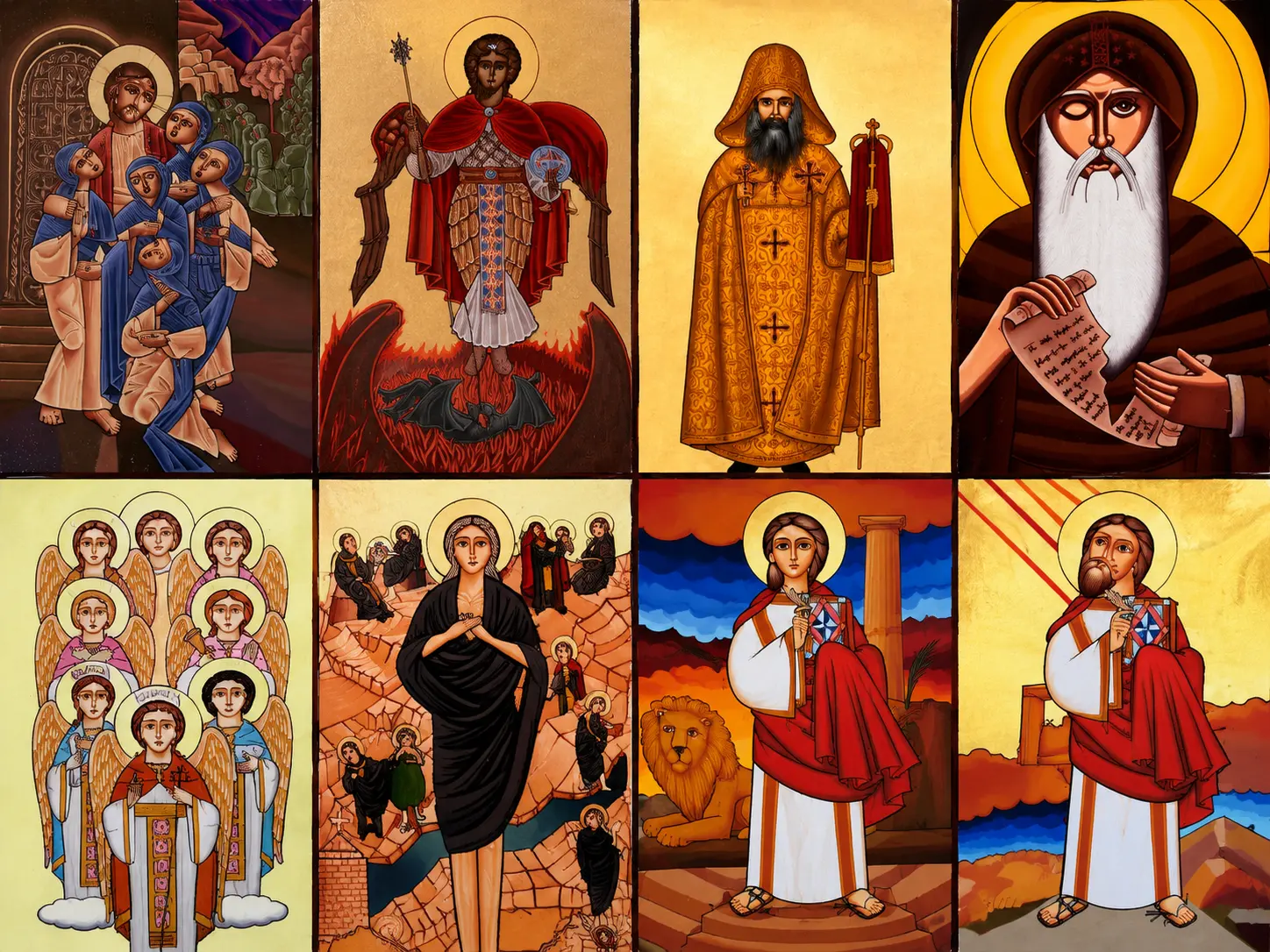
The Coptic Orthodox Church boasts a rich tapestry of saints, men and women who dedicated their lives to Christ and became beacons of faith, leaving behind legacies that continue to illuminate our path today. These holy figures are not merely distant figures in dusty chronicles; they are living examples of how to radiate God’s love and navigate the challenges of our earthly journey.
St. Paul the Hermit, considered the Father of Christian monasticism, embodied the pursuit of solitude and communion with God. As Scripture reminds us in Matthew 6:6, “But when you pray, go into your inner room, close your door and pray to your Father who is in secret, and your Father who sees in secret will reward you.” Heeding this call, St. Paul retreated to the desert, seeking a life stripped of worldly distractions. His example resonates with the Coptic emphasis on prayer and askesis, reminding us that true fulfillment lies in drawing closer to the divine.
Yet, the saints weren’t confined to solitary contemplation. St. George, the valiant soldier-martyr, exemplifies courage and unwavering faith in the face of persecution. As Romans 8:37 declares, “No, in all these things we are more than conquerors through him who loved us.” St. George refused to renounce his faith even under threat of torture and death, demonstrating the power of conviction and the ultimate victory of righteousness. His story inspires us to stand firm in our beliefs, even when confronted with opposition.
These are just two examples from the vast constellation of Coptic saints. Each has their own unique story, struggles, and contributions. Some were theologians and scholars, like St. Cyril of Alexandria, who defended the faith through their writings. Others, like St. Mary of Egypt, found redemption after a life of sin, showcasing God’s boundless forgiveness. Regardless of their specific roles, all Coptic saints share a common thread: a life transformed by Christ, radiating His love and serving as guiding lights for generations to come.
As St. Athanasius, a pillar of the Coptic Church, famously said, “God became human so that man might become God.” The lives of the saints demonstrate the reality of this transformation. They inspire us to strive for holiness, to emulate their unwavering faith, and to become living testaments to God’s grace in our own lives. By studying their stories and following their examples, we can all, in our own unique ways, become saints in the making, shining our own light in the world and illuminating the path for others.
Their prayers be with us all. Amen.
The Shining Stars of Coptic Orthodoxy
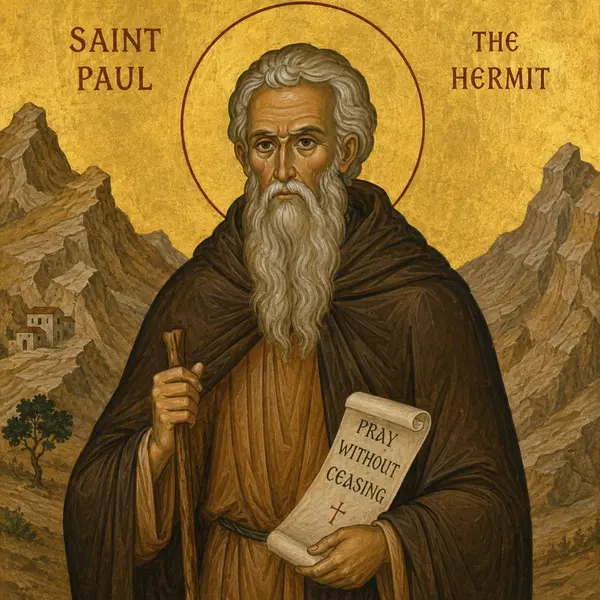
In the year 341 A.D., the great saint Anba Paul, the first hermit, departed. This Saint was from the city of Alexandria, and had a brother whose name was Peter.
After the departure of their father, they divided the inheritance between them. When his brother took the greater share, Paul’s feelings were hurt, by his brother’s action. He said to his brother, “Why don’t you give me my rightful share of the inheritance of my father?” Peter responded, “You are a young man, and I am afraid that you might squander it. As for me, I will keep it for you.”
When they did not agree with each other, they went to the governor to judge between them. On their way, they saw a funeral procession. Paul asked one of the mourners about the deceased man. Paul was told that he was one of the noble and rich people of the city, and that he left his riches and his wealth behind, and that they were taking him to bury him with only his garment.
St. Paul sighed in his heart and said to himself, “What do I have to do then with all the money of this temporal world which I shall leave naked?” He looked to his brother and said to him, “My brother, let us return, for I shall not ask you for anything, not even for what is mine.”
On their way back, Paul left his brother and went on his way until he came out of the city. Paul found a grave where he stayed for three days praying to the Lord Christ to guide him to what pleases Him. As for his brother, he searched for Paul diligently and when he did not find him, he was very sorry for what he had done.
God sent St. Paul an angel who took him out of this place, and walked with him until they reached the eastern inner wilderness. He stayed there for 70 years, during which he saw no one. He put on a tunic made of palm tree fiber. The Lord sent him a raven every day with a half loaf of bread.
When the Lord wanted to reveal the holiness of St. Paul and his righteousness, He sent His angel to St. Antony (Antonius) the Great, who thought that he was the first to dwell in the wilderness. The angel told St. Antony, “There is a man who lives in the inner wilderness; the world is not worthy of his footsteps. By his prayers, the Lord brings rain and dew to fall on the earth, and bring the flood of the Nile in its due season.”
When St. Antony heard this, he rose right away and went to the inner wilderness, a distance of one day’s walk. God guided him to the cave of St. Paul. He entered, and they bowed to each other, and sat down talking about the greatness of the Lord.
In the evening, the raven came bringing a whole loaf of bread. St. Paul said to St. Antony, “Now, I know that you are one of the children of God. For 70 years, the Lord has been sending to me everyday, half a loaf of bread, but today, the Lord is sending your food also. Now, go and bring me back in a hurry the tunic that Emperor Constantine had given to Pope Athanasius.”
St. Antony went to St. Athanasius, and brought the tunic from him and returned to St. Paul. On his way back, he saw the soul of St. Paul carried by the angels up to heaven. When he arrived to the cave, he found that St. Paul had departed from this world. He kissed him, weeping, and clothed him in the tunic that he asked for, and he took his fiber tunic.
When St. Antony wanted to bury St. Paul, he wondered how could he dig the grave? Two lions entered the cave, bowed their heads before the body of St. Paul, and shook their heads as if they were asking St. Anthony what to do. St. Antony knew that they were sent from God. He marked the length and width of the body on the ground, and they dug the grave with their claws, according to St. Antony’s directions. St. Anthony then buried the holy body, and went back to Pope Athanasius and told him what had happened. St. Athanasius sent men to bring St. Paul’s body to him. They spent several days searching in the mountains, but they could not find the place of his grave. St. Paul appeared to the Pope in a vision and told him that the Lord would not allow the revelation of the location of his body. He asked the Pope not to trouble the men, but to have them brought back.
Pope Athanasius used to put the palm fiber tunic on three times a year during the Divine Liturgy. One time, he wanted to let the people know about the holiness of the owner of that tunic. He put it over a dead man, and the dead man rose up instantly. The news of this miracle spread all around the land of Egypt.
His prayers be with us all. Amen.
St. Paul the Hermit, considered the Father of Christian monasticism, embodied the pursuit of solitude and communion with God. As Scripture reminds us in Matthew 6:6, “But when you pray, go into your inner room, close your door and pray to your Father who is in secret, and your Father who sees in secret will reward you.” Heeding this call, St. Paul retreated to the desert, seeking a life stripped of worldly distractions. His example resonates with the Coptic emphasis on prayer and askesis, reminding us that true fulfillment lies in drawing closer to the divine.
Yet, the saints weren’t confined to solitary contemplation. St. George, the valiant soldier-martyr, exemplifies courage and unwavering faith in the face of persecution. As Romans 8:37 declares, “No, in all these things we are more than conquerors through him who loved us.” St. George refused to renounce his faith even under threat of torture and death, demonstrating the power of conviction and the ultimate victory of righteousness. His story inspires us to stand firm in our beliefs, even when confronted with opposition.
These are just two examples from the vast constellation of Coptic saints. Each has their own unique story, struggles, and contributions. Some were theologians and scholars, like St. Cyril of Alexandria, who defended the faith through their writings. Others, like St. Mary of Egypt, found redemption after a life of sin, showcasing God’s boundless forgiveness. Regardless of their specific roles, all Coptic saints share a common thread: a life transformed by Christ, radiating His love and serving as guiding lights for generations to come.
As St. Athanasius, a pillar of the Coptic Church, famously said, “God became human so that man might become God.” The lives of the saints demonstrate the reality of this transformation. They inspire us to strive for holiness, to emulate their unwavering faith, and to become living testaments to God’s grace in our own lives. By studying their stories and following their examples, we can all, in our own unique ways, become saints in the making, shining our own light in the world and illuminating the path for others.
Their prayers be with us all. Amen.
St. George
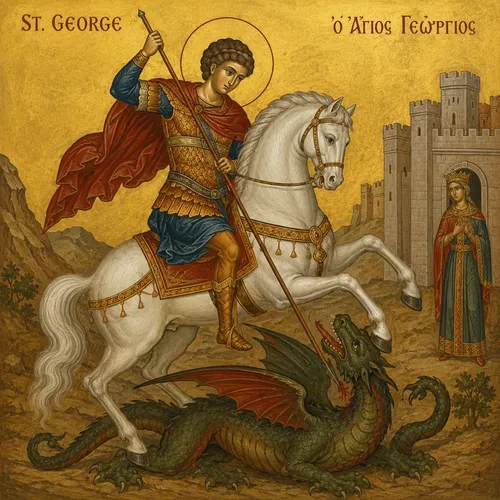
St. George was born about 280 A.D. of a Christian family that was wealthy and of noble origin, in the city of Cappadocia, a city of the Eastern Empire, in Asia Minor.
He followed the usual career of young nobleman and joined the Roman army, where his ability and charm brought him quick promotion. The Emperor heard about him and as a result made him a tribune or an officer in the Imperial Guard.
One story says that he was a friend of Constantine another officer, who later became the first Christian emperor. The legend says that St. George came with Constantine to Britain and visited some holy places as Glastonbury and Caerleon. On his return to Nicomedia, the capital of the Eastern Empire where Diocletian settled, he met the fiery storm of persecution.
Diocletian gave orders for the issue of a formal edict against the Christians on February 23, in the year 303 A.D. The provisions of this edict which was published on the next day in the market place, were as follows: “All churches should be levelled to the ground. All sacred books to be burned. All Christians who hold any honorable rank are not only to be degraded, but to be deprived of civil rights. Also, All Christians who are not officials are to be reduced to slavery.
In great courage, the young man George, pushed his way through the market place to read the proclamation, and then in front of the awe-stricken crowd, he deliberately tore down the imperial edict and threw it away. Consequently he was arrested and brought to the presence of Diocletian.
Some historians believe that St. George was not the young man who tore the proclamation, but as the edict was proclaimed and the great church in Nicomedia was ransacked and destroyed by the pretorian guard, he liberated his slaves, distributed all his wealth to the poor and prepared himself for martyrdom. He entered Diocletian’s palace and rebuked him for his behavior against the Christians.
The Emperor tried to seduce him by promises that he would be granted a higher position in the Empire. But as these promises failed to attract him, the Emperor began to threaten him with unbearable tortures that he will inflict on him. Lastly he put him in prison.
Diocletian knew that nothing, except sin, could destroy the strength, and demolish the integrity of this Saint. Thus he arranged for a very beautiful woman to spend the night with him in prison and try to debauch him. St. George who could only look forward to heavenly joy, began to pray and within a short while he managed to swing her heart to the Christian faith. Soon she seriously began to inquire about salvation, and by the morning she declared that she found her true Bridegroom Jesus Christ. With great courage she announced her Christianity to the emperor and joined the other saintly martyrs.
St. George’s body was torn by a special instrument that had metallic teeth, and our Lord Jesus rose him, after his death and many pagans were converted. He was put in a active lime, and then water was poured on it. Again the Lord returned him back to life. The emperor became very agitated, imagining that the Saint was using magic. He called his top magician, Athanasius and requested him to prepare a lethal dose of poison to kill St. George. The Saint signed over the cup with the sign of the Cross before drinking it, of course no harm came to him. The Emperor’s councilors informed him that St. George’s magic was in fact contained in the sign of the Cross itself. Another cup was also given to the Saint, but this time with his hands tied behind his back. The Saint signed it by his head saying: “shall I drink it from here or here or here or here!!!”
During all these tortures, although the Saint had enough pains and sufferings of his own, but nevertheless kept on talking to Diocletian about the powers of the Christian faith. At the end the Emperor asked him if he could raise a dead man he knew of. St. George prayed to our Lord and the dead man came back to life. The result of that was the conversion of both the dead man and the magician as well as many others. They all were martyred.
When all methods failed to incite St. George, the Emperor invited him in his palace to entertain him. He offered him an appointment as a prince if he only sacrificed once to the idols. The Saint replied “Tomorrow you will see the powers of your gods”. At the palace, St. George met Empress Alexandra, who had a fair idea about the Saint’s God. She spoke with him, but the conversation quickly changed its course and the Saint began to preach to her about Jesus Christ, the Savior of the world.
The following day many people went to the temple to witness St. George’s sacrifice to the idols. The Saint stretched his hands, raised his eyes to heaven and in a moment, the idols collapsed and fell to the ground!! The crowds shouted “we believe in George’s God”. At this, the Emperor and his men put an end to the lives of the new Christians, St. George, and Empress Alexandra in 23 Baramouda, 303 A.D.
St. George was buried in his mother’s home that was situated on the seashore at Lydda, in Palestine. Before long his fame was spread all over the world. King Constantine, who took over after Diocletian, considered St. George was the true model of the young Christian man, and ordered a church to be built over his grave. In Egypt, the Copts call him, “The Prince of Martyrs”, and built over 200 churches named after him. Moreover he is a personal friend of the majority of Copts, who believe in the power of his prayers for them. The Greeks call him “the Great Martyr”.
His prayers be with us all. Amen.